Effectiveness of Follow-Up on Performance Auditing Issues in Practice: A Governance Network Perspective
DOI:
https://doi.org/10.22452/AJAP.vol13no1.1Keywords:
Performance Auditing, Follow-Up Practice, Governance Arrangement, Networking, Governance NetworkAbstract
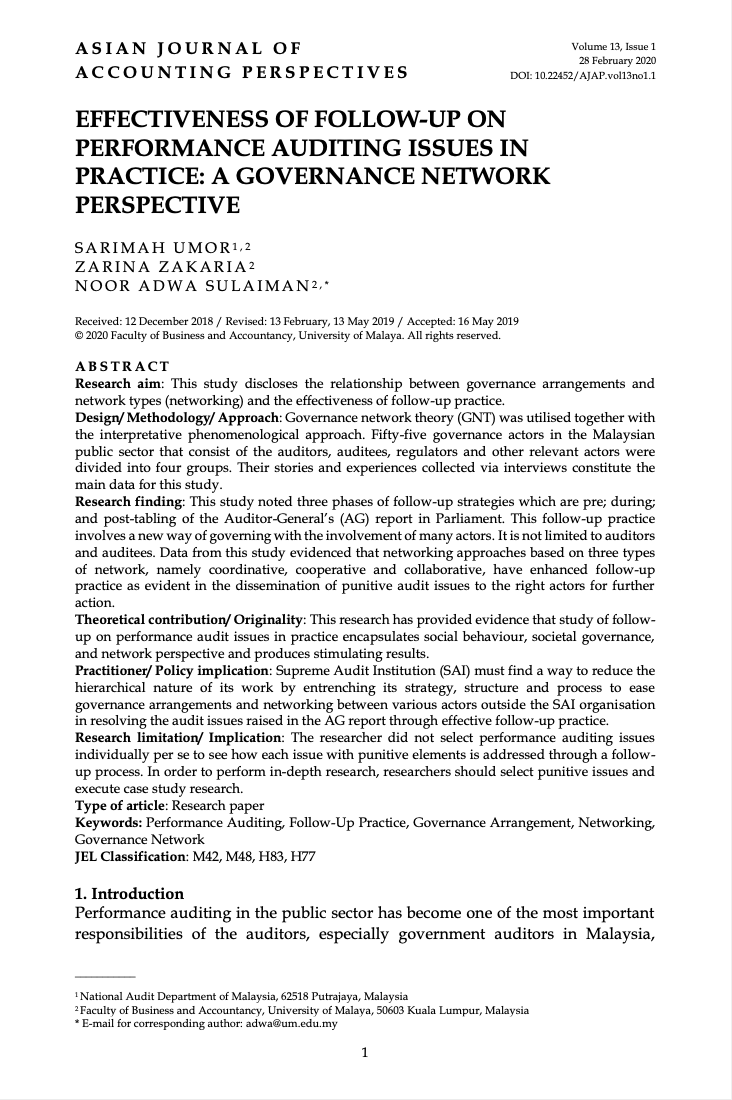
Research aim: This study discloses the relationship between governance arrangements and network types (networking) and the effectiveness of follow-up practice.
Design/ Methodology/ Approach: Governance network theory (GNT) was utilised together with the interpretative phenomenological approach. Fifty-five governance actors in the Malaysian public sector that consist of the auditors, auditees, regulators and other relevant actors were divided into four groups. Their stories and experiences collected via interviews constitute the main data for this study.
Research finding: This study noted three phases of follow-up strategies which are pre; during; and post-tabling of the Auditor-General’s (AG) report in Parliament. This follow-up practice involves a new way of governing with the involvement of many actors. It is not limited to auditors and auditees. Data from this study evidenced that networking approaches based on three types of network, namely coordinative, cooperative and collaborative, have enhanced follow-up practice as evident in the dissemination of punitive audit issues to the right actors for further action.
Theoretical contribution/ Originality: This research has provided evidence that study of follow-up on performance audit issues in practice encapsulates social behaviour, societal governance, and network perspective and produces stimulating results.
Practitioner/ Policy implication: Supreme Audit Institution (SAI) must find a way to reduce the hierarchical nature of its work by entrenching its strategy, structure and process to ease governance arrangements and networking between various actors outside the SAI organisation in resolving the audit issues raised in the AG report through effective follow-up practice.
Research limitation/ Implication: The researcher did not select performance auditing issues individually per se to see how each issue with punitive elements is addressed through a follow-up process. In order to perform in-depth research, researchers should select punitive issues and execute case study research.
Type of article: Research paper
Keywords: Performance Auditing, Follow-Up Practice, Governance Arrangement, Networking, Governance Network
JEL Classification: M42, M48, H83, H77
Downloads
Published
Issue
Section
License
License
The Asian Journal of Accounting Perspectives (AJAP) articles are published under a licence equivalent to the Creative Commons Attribution-NonCommercial-NoDerivs License (CC BY-NC-ND). The licence allows users to copy, distribute, and transmit an article as long as the author is attributed. The article is not used for commercial purposes. The work is not modified or adapted in any way.
Copyright
Authors are required to sign the Exclusive License to Publish agreement upon publication in the AJAP. The agreement grants the Publisher (Faculty of Business and Accountancy, Universiti Malaya) to publish and disseminate the articles.
Open Access
Articles published in the AJAP are digital, online, free of charge, and free of most copyright and licensing restrictions.
Article Processing Charge
Articles publish in AJAP is free submission, production and publication charges. However, all accepted articles are required for language editing. The AJAP officially appointed and outsourced proofreader will conduct this process, and the authors will cover the cost. AJAP does not profit from this process and transaction.