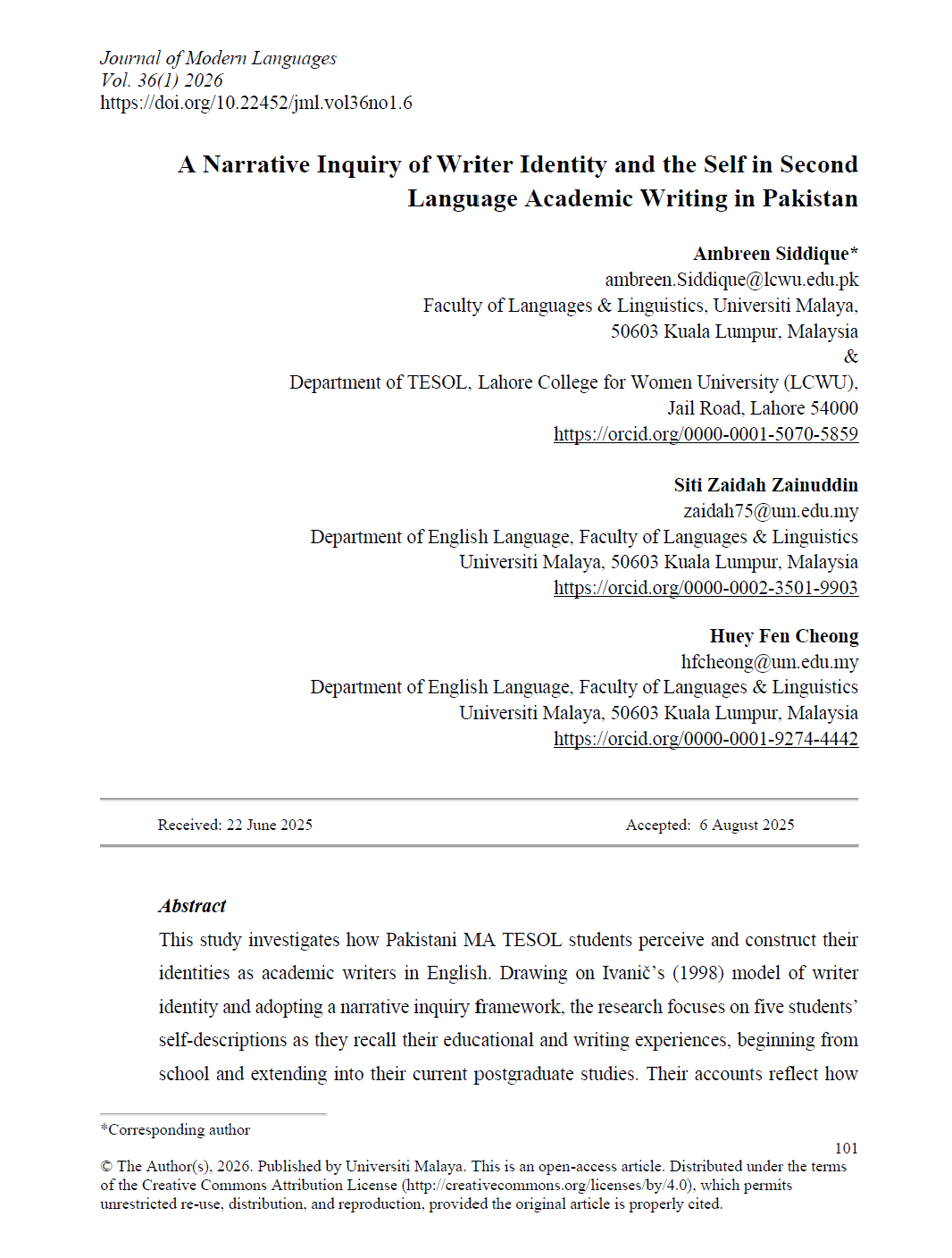
A narrative inquiry of writer identity and the self in second language academic writing in Pakistan
DOI:
https://doi.org/10.22452/jml.vol36no1.6Keywords:
Writer Identity and the Self, Second Language Writing, Narrative Inquiry, Pakistani TESOL Students, Discoursal-SelfAbstract
This study investigates how Pakistani MA TESOL students perceive and construct their identities as academic writers in English. Drawing on Ivanič’s (1998) model of writer identity and adopting a narrative inquiry framework, the research focuses on five students’ self-descriptions as they recall their educational and writing experiences, beginning from school and extending into their current postgraduate studies. Their accounts reflect how prior schooling, language background, and classroom experiences influence the autobiographical-self, shaping how they view their abilities and roles as writers. The data further reveal how students engage with academic discourse practices, adopting or challenging conventions to shape a discoursal-self that aligns with expectations while retaining aspects of their personal voice in writing. As their writing skills develop, the participants describe gradual shifts toward a stronger authorial-self, an identity marked by increased confidence, agency, and a sense of ownership. The study shows that second-language academic writing involves ongoing self-positioning and calls for teaching approaches that value students’ linguistic backgrounds and personal learning histories, offering support that encourages confidence and identity development.
Downloads
Published
Issue
Section
Categories
License
Copyright (c) 2026 Ambreen Siddique, Siti Zaidah Binti Zainuddin, Huey Fen Cheong

This work is licensed under a Creative Commons Attribution-NonCommercial 4.0 International License.