Artificial Intelligent (AI) Model for Generating Lessons Of Quranic Chapters Through An Interactive Tafsir Approach Based On Natural Language Processing (NLP) And Machine Learning (ML)
DOI:
https://doi.org/10.22452/quranica.vol17no2.1Keywords:
Artificial Intelligent (AI); Natural Language Processing (NLP); Machine Learning (ML); Semi-Supervised Learning (SSL)Abstract
The Qur’an is the primary source of guidance for Muslims; however, a deep understanding of its teachings remains limited to static authoritative works that require manual searching. This limitation creates a challenge for users who struggle to access the teachings of the verses in a systematic and interactive manner. This study proposes the development of an Artificial Intelligence (AI) model that applies Natural Language Processing (NLP) and Machine Learning approaches to automatically generate benefits and lessons from the chapters of the Qur’an. The model is designed to function by receiving the name of a surah as input from the user, extracting the relevant tafsir content, summarizing the key teachings, and delivering explanations that are concise, coherent, and easy to understand. The study’s methodology consists of several main phases, including the selection of a tafsir dataset (based on Tafsir al-Azhar by HAMKA), followed by linguistic pre-processing, machine learning model development, implementation of the NLP pipeline, and a fact-verification procedure to ensure the accuracy and reliability of the generated output. The proposed approach not only facilitates greater access to tafsir knowledge but also empowers digital Islamic education through a system that is both responsive and adaptive.
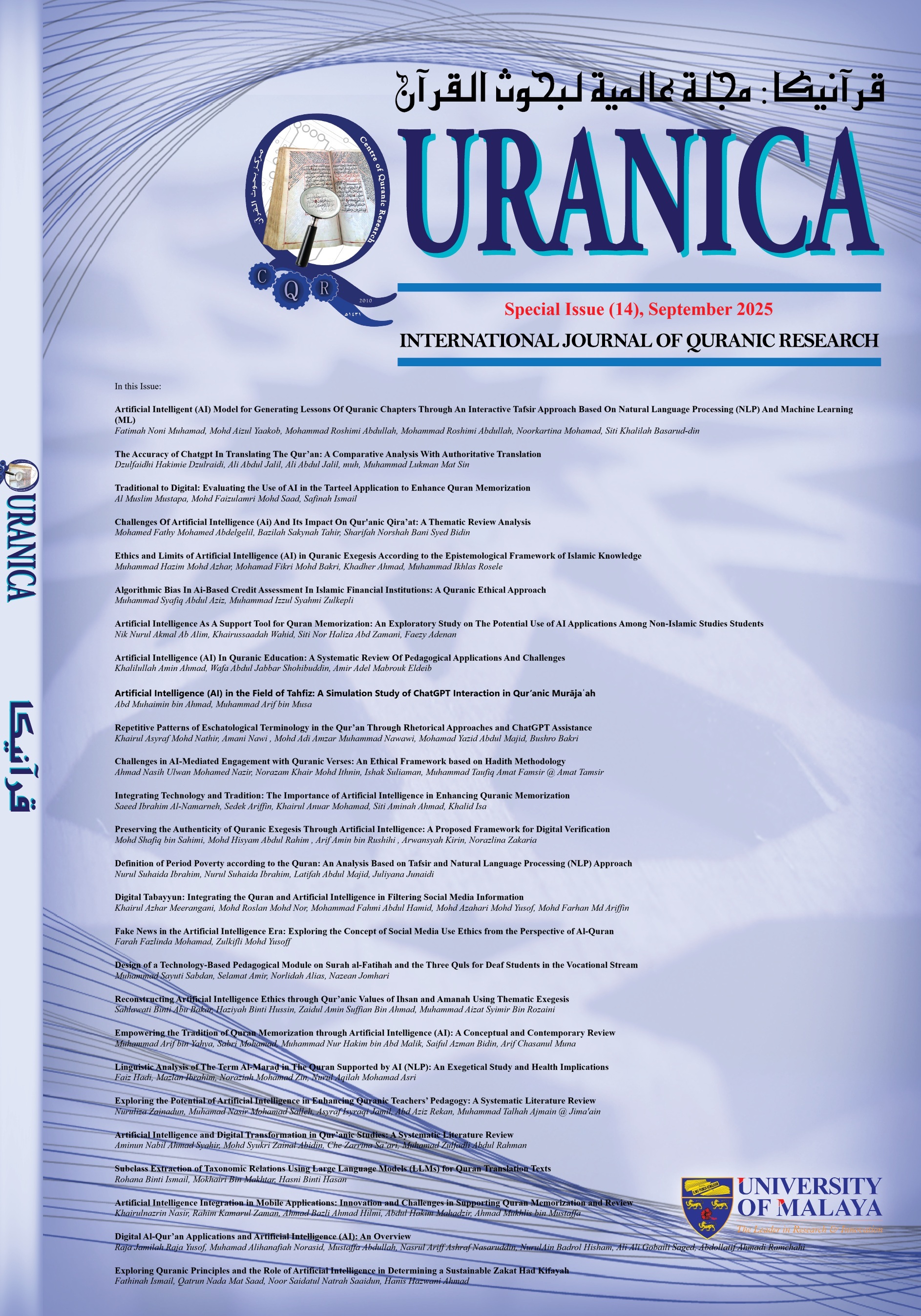
Downloads
Published
Issue
Section
License
Disclaimer
QURANICA makes every effort to ensure the accuracy of all its contents. However, opinions, discussions, views and recommendations are expressed in this journal do not necessarily reflect the official policy of QURANICA or views of its editors or publishers. Therefore, QURANICA and its publishers will not be liable for any controversy may be arisen. The journal reserves the right, at its sole discretion, to change its terms and conditions of publications.
Copyright
It is a condition of publication that manuscript submitted to the journal have not been published, accepted for publication, nor simultaneously submitted for publication elsewhere. By submitting a manuscript, the author(s) agrees that copyright for the article is transferred to the publisher, if and when the manuscript is accepted for publication.