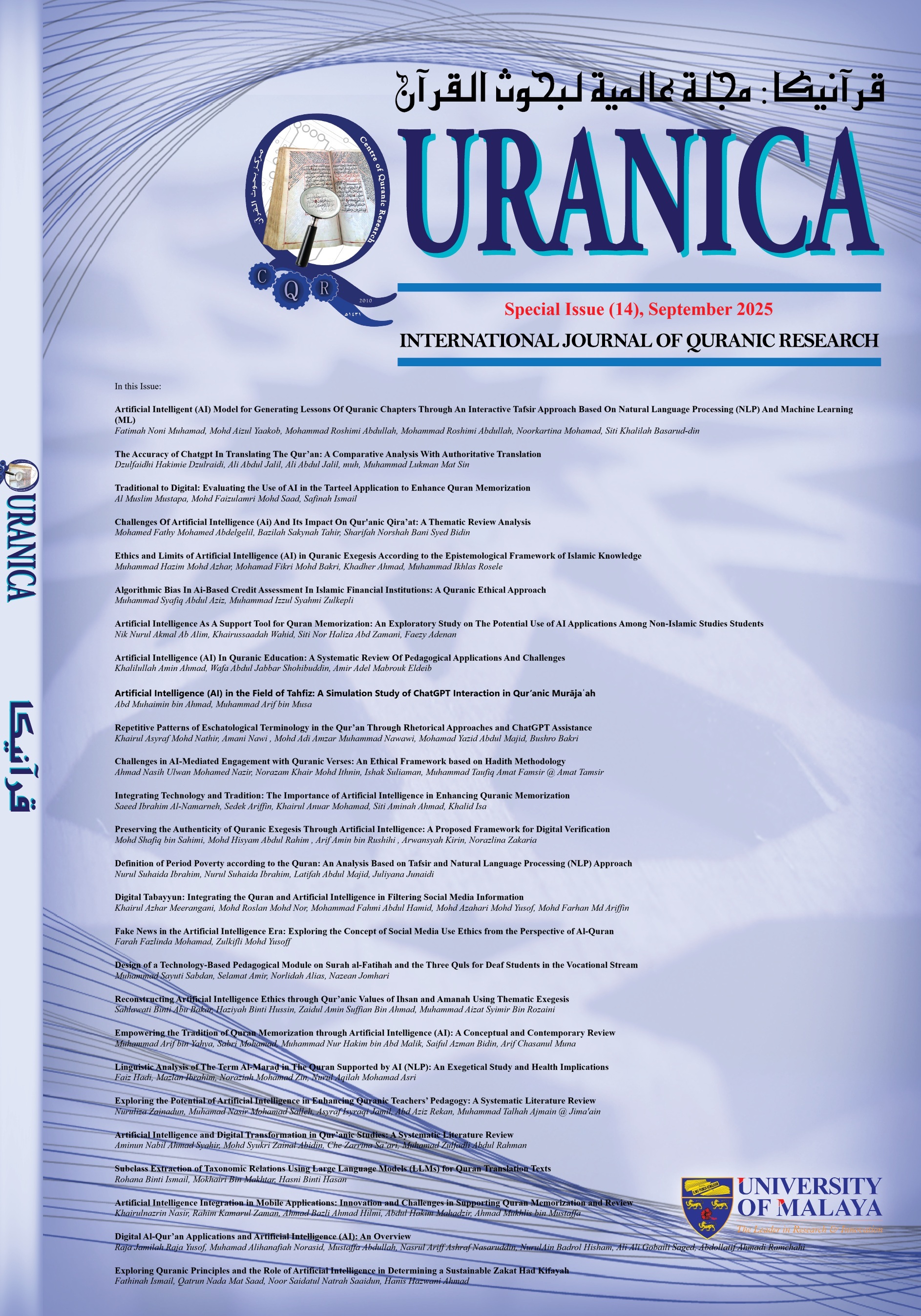
The Accuracy of Chatgpt In Translating The Qur’an: A Comparative Analysis With Authoritative Translation
DOI:
https://doi.org/10.22452/quranica.vol17no2.2Keywords:
Artificial Intelligence (AI); Chatgpt; Qur’an; Tafsir Pimpinan Al-Rahman; Qur’anic StudiesAbstract
The emergence of generative Artificial Intelligence (AI) technologies such as ChatGPT has opened up new dimensions in text translation, including complex sacred texts like the Qur’an. However, the capability and accuracy of ChatGPT in translating Qur’anic verses remain in need of critical evaluation, as any distortion of meaning can have significant implications for the understanding of the Muslim community. This study was conducted to assess to what extent ChatGPT translations, both free and paid versions, can be compared to authoritative translations that have undergone expert verification, such as Tafsir Pimpinan al-Rahman Kepada Pengertian al-Quran by Abdullah Basmeih. This study employed a qualitative research design with a content analysis approach, focusing on four selected surahs: al-Ikhlāṣ, al-Falaq, al-Nās and al-Kauthar. The findings show that ChatGPT version 4.0 demonstrates better accuracy in meaning compared to version 3.0, particularly in terms of the clarity of terminology and sentence structure. Nevertheless, both versions still exhibit weaknesses in maintaining subtle interpretive nuances, consistency of style, and a tendency to add or omit elements that require expert review to preserve the intended meaning. In conclusion, ChatGPT should only serve as an initial reference tool and cannot fully replace the role of authoritative translations grounded in the discipline of Qur’anic studies. This study recommends that future research expand the scope to include longer and more complex verses, as well as develop clear guidelines for the use of AI in translating sacred texts within Islamic education and research contexts.
Downloads
Published
Issue
Section
License
Disclaimer
QURANICA makes every effort to ensure the accuracy of all its contents. However, opinions, discussions, views and recommendations are expressed in this journal do not necessarily reflect the official policy of QURANICA or views of its editors or publishers. Therefore, QURANICA and its publishers will not be liable for any controversy may be arisen. The journal reserves the right, at its sole discretion, to change its terms and conditions of publications.
Copyright
It is a condition of publication that manuscript submitted to the journal have not been published, accepted for publication, nor simultaneously submitted for publication elsewhere. By submitting a manuscript, the author(s) agrees that copyright for the article is transferred to the publisher, if and when the manuscript is accepted for publication.