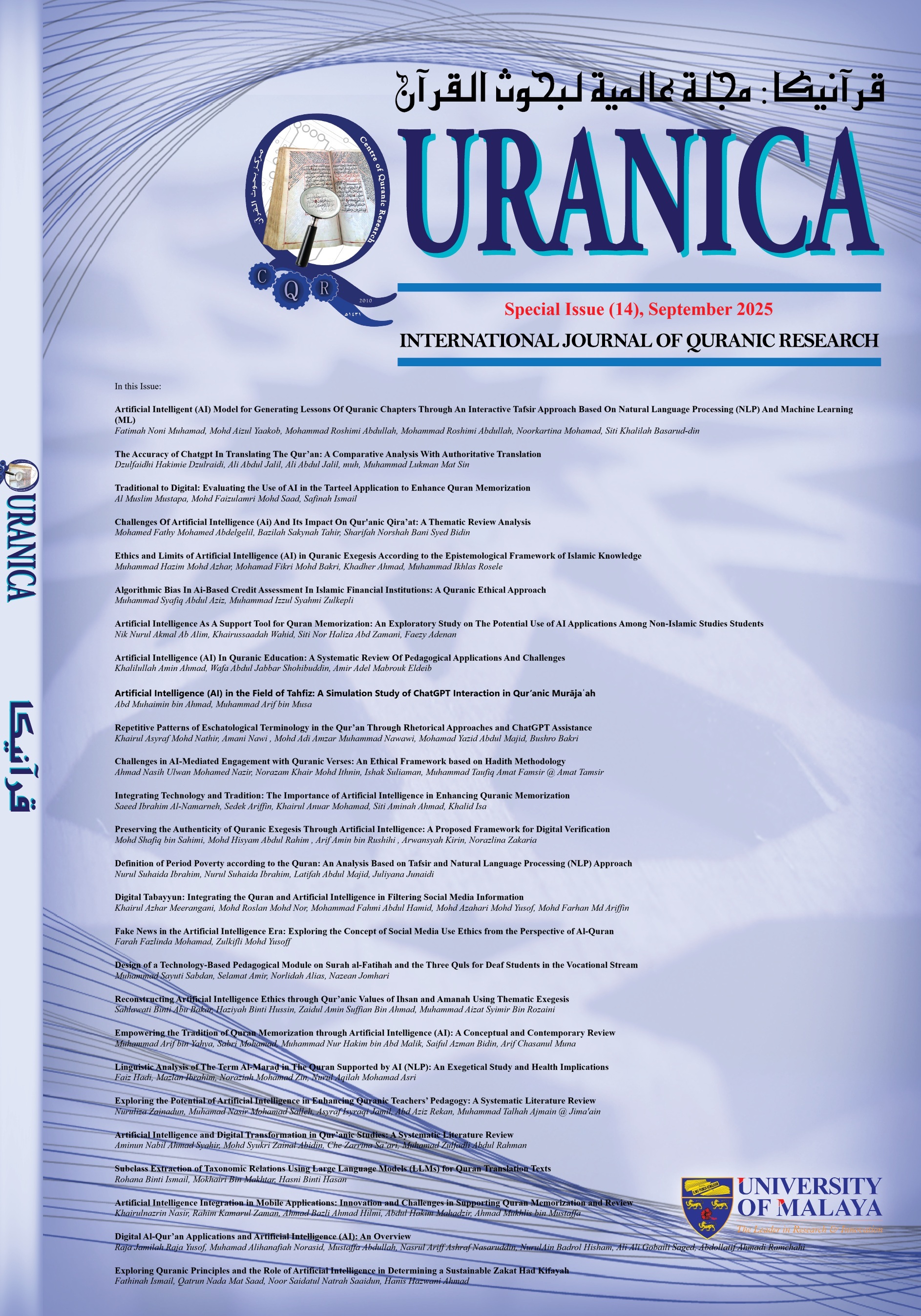
Ethics and Limits of Artificial Intelligence (AI) in Quranic Exegesis According to the Epistemological Framework of Islamic Knowledge
DOI:
https://doi.org/10.22452/quranica.vol17no2.5Keywords:
Quranic Exegesis, Artificial Intelligence (AI), Ethics, Islamic EpistemologyAbstract
The emergence of Artificial Intelligence (AI) technologies has had a significant impact on various aspects of human life, including religious discourse and Quranic interpretation. AI, which relies on natural language processing (NLP) and machine learning, has increasingly been employed to understand and interpret the Quran through automated approaches. However, the application of AI in the field of tafsir (Quranic exegesis) raises critical ethical and epistemological concerns from the perspective of Islamic knowledge, particularly regarding the authority of knowledge, the sanctity of revealed texts, and the role of traditional scholars especially the mufassirun, as authoritative interpreters of the Quran. This article aims to assess the current forms of AI application in the context of Quranic interpretation, identify the ethical boundaries and associated risks, and analyse the implications for the epistemological structure of Islamic sciences. Employing a qualitative analytical approach, the study draws upon both primary and secondary sources, including classical tafsir texts, scholarly opinions, and contemporary discussions on technology and Islamic law. The findings suggest that AI should serve as a secondary assistive tool in Quranic studies rather than as an autonomous exegete or primary interpretive authority. Unregulated use of AI poses the risk of distorting religious understanding and undermining the legitimacy of the Islamic intellectual tradition. Accordingly, this article proposes an Islamic ethical framework in the form of guidelines that emphasise the necessity of human oversight in AI applications, particularly in matters involving divine revelation, to harness AI's potential responsibly without compromising the integrity of Quranic exegesis.
Downloads
Published
Issue
Section
License
Disclaimer
QURANICA makes every effort to ensure the accuracy of all its contents. However, opinions, discussions, views and recommendations are expressed in this journal do not necessarily reflect the official policy of QURANICA or views of its editors or publishers. Therefore, QURANICA and its publishers will not be liable for any controversy may be arisen. The journal reserves the right, at its sole discretion, to change its terms and conditions of publications.
Copyright
It is a condition of publication that manuscript submitted to the journal have not been published, accepted for publication, nor simultaneously submitted for publication elsewhere. By submitting a manuscript, the author(s) agrees that copyright for the article is transferred to the publisher, if and when the manuscript is accepted for publication.