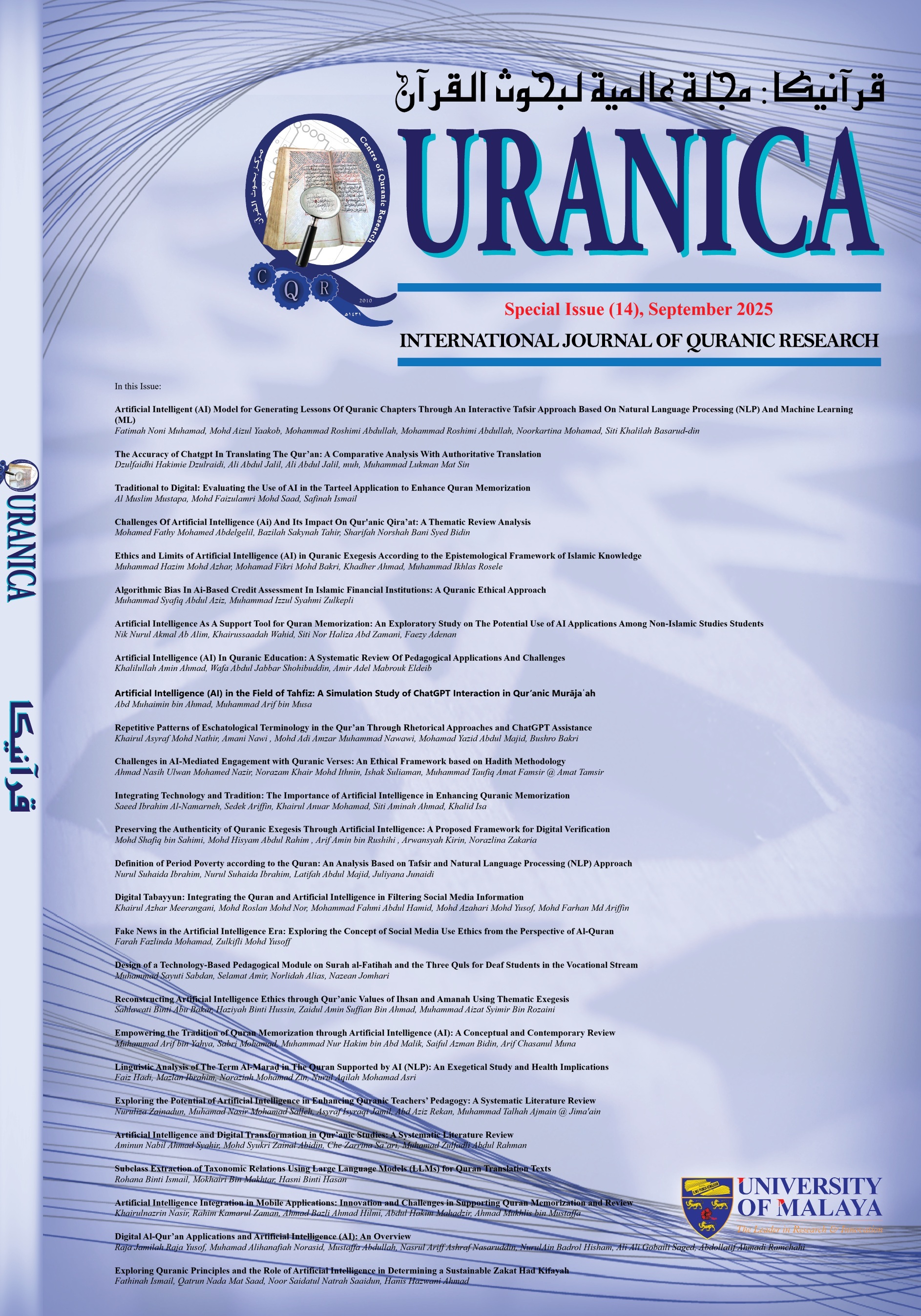
Algorithmic Bias In Ai-Based Credit Assessment In Islamic Financial Institutions: A Quranic Ethical Approach
DOI:
https://doi.org/10.22452/quranica.vol17no2.6Keywords:
Algorithmic Bias, AI, Shariah Ethics, al-Qur’an, Credit Assessment, Islamic FinanceAbstract
The use of artificial intelligence (AI) is widespread across various sectors, including Islamic financial institutions, particularly in credit assessment processes. While AI offers enhanced efficiency and financial inclusion, it also raises concerns regarding algorithmic bias issues, such as data bias, model bias, lack of transparency, and misalignment with Shariah principles. These issues pose ethical challenges that may contradict core Quranic values such as justice , trustworthiness, and the prohibition of injustice. Accordingly, this study aims to examine the issue of algorithmic bias in AI-based credit assessment within Islamic financial institutions in light of ethical principles outlined in the al-Qur'an, and to propose Quranic ethical values that can form the basis for a Shariah-compliant AI ethics framework. This research adopts a qualitative content analysis approach by examining academic literature, industry standards, and relevant Quranic verses along with authoritative tafsir to identify key algorithmic bias issues and to derive suitable Quranic ethical principles for AI implementation in credit assessment. The findings indicate that algorithmic bias may lead to violations of Shariah principles, such as unjust credit decisions, discrimination against underserved populations, and inadequate screening of prohibited elements. The proposed Quranic ethical standards including justice, transparency, trust, and the pursuit of public interest should be integrated into every stage of AI design and implementation in credit assessment. This study provides significant implications for the Islamic finance industry by offering a Quranic-based ethical framework to guide financial institutions, policymakers, and technology developers in ensuring that AI applications in credit assessment remain Shariah-compliant, fair, and ethically sound in future financial operations.
Downloads
Published
Issue
Section
License
Disclaimer
QURANICA makes every effort to ensure the accuracy of all its contents. However, opinions, discussions, views and recommendations are expressed in this journal do not necessarily reflect the official policy of QURANICA or views of its editors or publishers. Therefore, QURANICA and its publishers will not be liable for any controversy may be arisen. The journal reserves the right, at its sole discretion, to change its terms and conditions of publications.
Copyright
It is a condition of publication that manuscript submitted to the journal have not been published, accepted for publication, nor simultaneously submitted for publication elsewhere. By submitting a manuscript, the author(s) agrees that copyright for the article is transferred to the publisher, if and when the manuscript is accepted for publication.