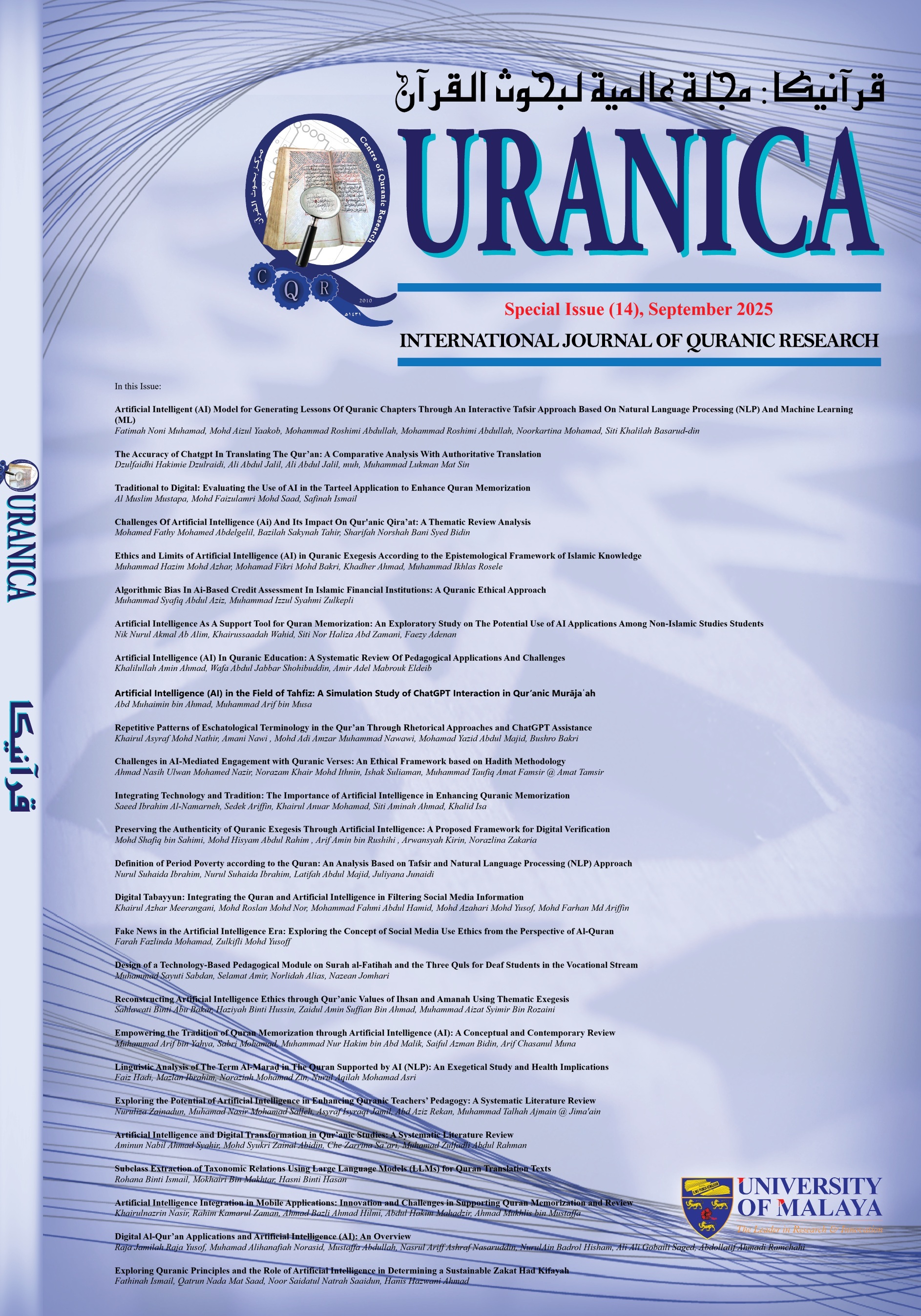
Design of a Technology-Based Pedagogical Module on Surah al-Fatihah and the Three Quls for Deaf Students in the Vocational Stream
DOI:
https://doi.org/10.22452/quranica.vol17no2.17Keywords:
Module Design, Pedagogy, Qur’anic Education, Deaf Learners, Vocational StreamAbstract
Qur'anic education is an essential form of learning for every Muslim around the world. However, its implementation for deaf students remains significantly underdeveloped, particularly among those in vocational education streams. Therefore, this study aims to design a technology-based instructional module focusing on Surah al-Fatihah and the Three Quls (al-Ikhlas, al-Falaq, and al-Nas) tailored for deaf students in vocational programs, utilizing the Fuzzy Delphi Method (FDM). The objectives of this study are to obtain expert consensus on the module’s goals, content, technological components, activities, and assessment methods. Ten expert panellists were interviewed to develop relevant items based on FDM. The resulting instrument comprised six sections with a total of 52 questionnaire items. These questionnaires were subsequently distributed to 19 experts from various fields to gather consensus. The findings revealed that all items achieved a consensus threshold with a ‘d’ value ≤ 0.2, and over 75% agreement among the panellists. This study provides significant implications for religious education for deaf students in vocational streams. Moreover, the developed module serves as a practical guide for teachers and students in the teaching and learning of the Qur’an for learners with hearing impairments.
Downloads
Published
Issue
Section
License
Disclaimer
QURANICA makes every effort to ensure the accuracy of all its contents. However, opinions, discussions, views and recommendations are expressed in this journal do not necessarily reflect the official policy of QURANICA or views of its editors or publishers. Therefore, QURANICA and its publishers will not be liable for any controversy may be arisen. The journal reserves the right, at its sole discretion, to change its terms and conditions of publications.
Copyright
It is a condition of publication that manuscript submitted to the journal have not been published, accepted for publication, nor simultaneously submitted for publication elsewhere. By submitting a manuscript, the author(s) agrees that copyright for the article is transferred to the publisher, if and when the manuscript is accepted for publication.