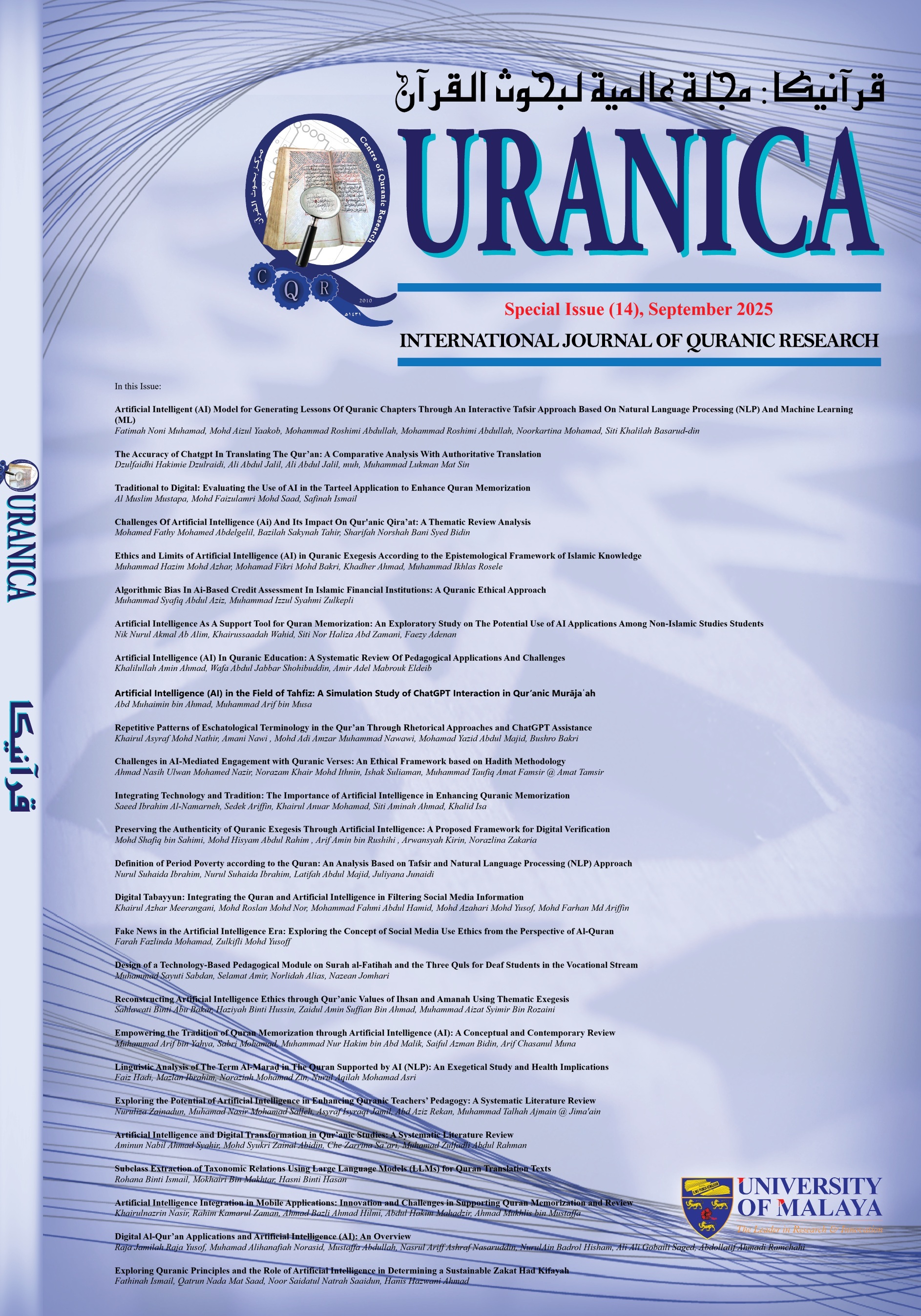
Exploring Quranic Principles and the Role of Artificial Intelligence in Determining a Sustainable Zakat Had Kifayah
DOI:
https://doi.org/10.22452/quranica.vol17no2.26Keywords:
Qur’an, Had Kifayah, Zakat Distribution, Artificial Intelligence, Sustainability, SDGsAbstract
This study aims to explore the Qur’anic principles in determining had kifayah and to assess the role of artificial intelligence (AI) in supporting sustainable zakat distribution management. Using a qualitative approach with tafsir mawḍū‘ī (thematic exegesis) and thematic analysis of relevant Qur’anic verses, the study identifies four mains had kifayah principles: basic needs, social justice, economic sustainability, and the determination of asnaf. The findings indicate that the Qur’an emphasizes a balance between worldly and spiritual obligations, fairness in wealth distribution, and the protection of the welfare of those in need. In a modern management context, AI is seen as a complementary tool that can enhance efficiency, transparency, and accuracy in determining had kifayah through data profiling, predictive analytics, and decision-support systems grounded in Islamic values. Therefore, the integration of divine principles and technology can create a more targeted and inclusive zakat ecosystem, aligning with the Sustainable Development Goals (SDGs).
Downloads
Published
Issue
Section
License
Disclaimer
QURANICA makes every effort to ensure the accuracy of all its contents. However, opinions, discussions, views and recommendations are expressed in this journal do not necessarily reflect the official policy of QURANICA or views of its editors or publishers. Therefore, QURANICA and its publishers will not be liable for any controversy may be arisen. The journal reserves the right, at its sole discretion, to change its terms and conditions of publications.
Copyright
It is a condition of publication that manuscript submitted to the journal have not been published, accepted for publication, nor simultaneously submitted for publication elsewhere. By submitting a manuscript, the author(s) agrees that copyright for the article is transferred to the publisher, if and when the manuscript is accepted for publication.