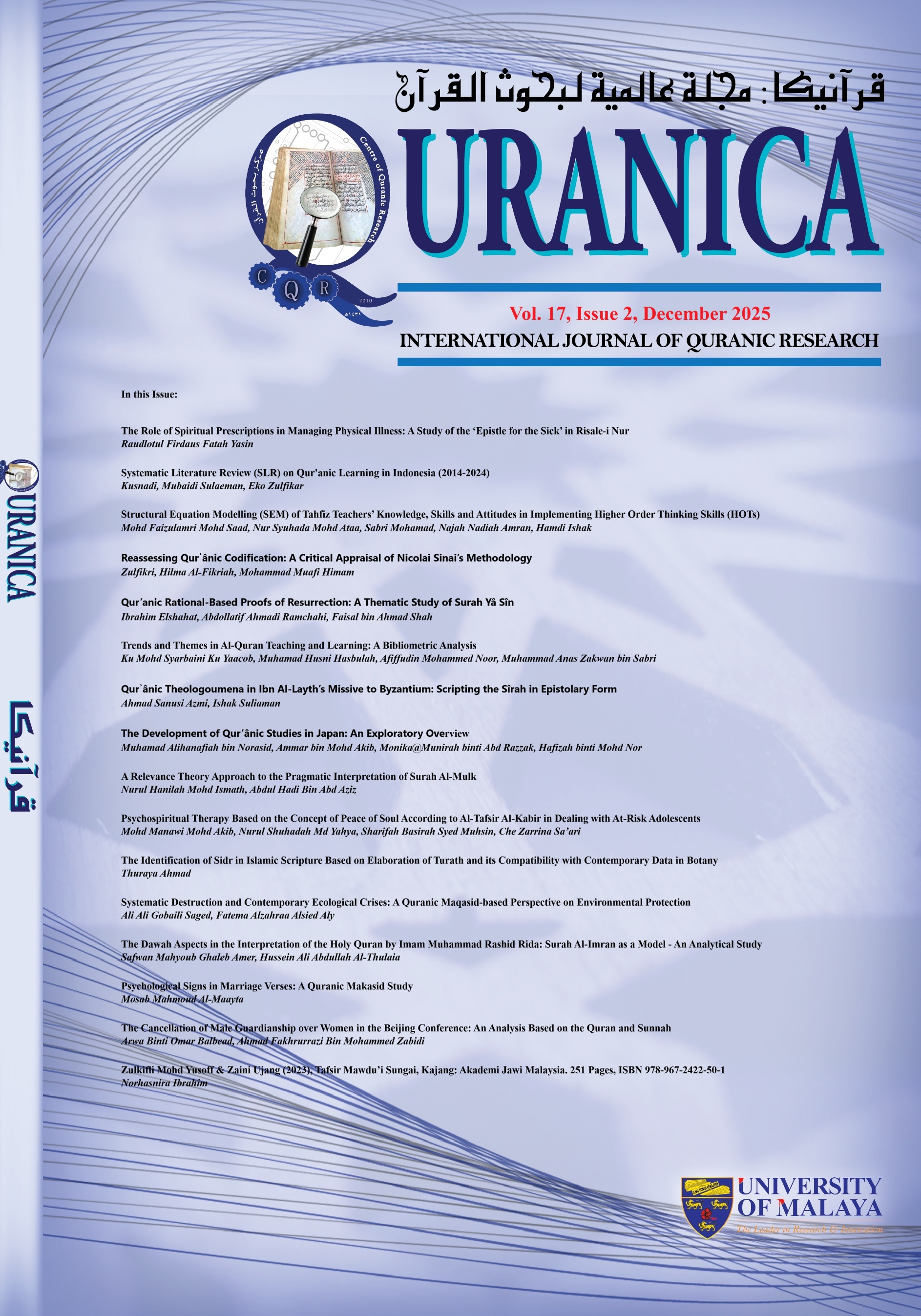
The Role of Spiritual Prescriptions in Managing Physical Illness: A Study of the ‘Epistle for the Sick’ in Risale-i Nur
DOI:
https://doi.org/10.22452/quranica.vol17no2.27Keywords:
Risale-i Nur, Epistle to the Sick, Spiritual Healing, Qur’anic Perspective, Post-COVID Mental Health.Abstract
This study explores Epistle for the Sick by Bediuzzaman Said Nursi (1877–1960), part of the Risale-i Nur collection, which offers spiritual guidance for managing physical illness through Qur’anic insights. Nursi interprets health and sickness as complementary aspects of human existence, where illness serves as a means of purification, reflection, and closeness to Allah. In the post-COVID-19 era, global health challenges have not only affected the body but also weakened mental and spiritual resilience due to prolonged isolation and fear. Adopting Nursi’s framework, this paper examines illness as a spiritual opportunity rather than a misfortune. Using a qualitative-inductive methodology, data from primary and secondary sources were analyzed thematically. Findings reveal that illness, when viewed through a Qur’anic lens, should not be feared but embraced as a divine blessing that brings lessons, patience, gratitude, and moral refinement. Nursi emphasizes that sickness can serve as an investment for eternal success in the Hereafter, teaching believers reliance on divine mercy and avoidance of sinful behavior. The paper further argues that modern secular educational models, particularly those influenced by Western philosophies, have overshadowed spiritual and moral development. In contrast, Nursi’s Qur’anic perspective promotes balance between material knowledge and spiritual wisdom. His teachings provide a holistic approach to healing—uniting body, mind, and soul. In the post-pandemic context, this spiritual framework offers individuals renewed faith, resilience, and inner peace while underscoring the need for educational reform that integrates Islamic and modern paradigms.
Downloads
Published
Issue
Section
License
Disclaimer
QURANICA makes every effort to ensure the accuracy of all its contents. However, opinions, discussions, views and recommendations are expressed in this journal do not necessarily reflect the official policy of QURANICA or views of its editors or publishers. Therefore, QURANICA and its publishers will not be liable for any controversy may be arisen. The journal reserves the right, at its sole discretion, to change its terms and conditions of publications.
Copyright
It is a condition of publication that manuscript submitted to the journal have not been published, accepted for publication, nor simultaneously submitted for publication elsewhere. By submitting a manuscript, the author(s) agrees that copyright for the article is transferred to the publisher, if and when the manuscript is accepted for publication.